


Your problems might be worth more than you think.
Yes, your problems.
There is a $1 million business idea hiding in your life right now.
What’s even crazier is that this business is hidden inside a problem you have already solved.
And there is a good chance you are completely ignoring it.
Not because it requires money to start.
Not because you need investors.
Not because you need employees.
Besides, you can launch this specific business today for $0 and start earning from it.
Think about that.
This is the business:
Solve your problems. Sell the solution.
So first, before we get into the data and how to build this kind of business for you. Let’s talk about problems. Why am I saying solve your problems and sell the solution?
At some point in your life, you have probably struggled with something(who hasn’t?).
Let’s say you figured out how to do one of the following:
get out of debt
organize your chaotic schedule
prepare healthy meals cheaply
become more productive
study while working full-time
or fix some incredibly mundane problem
If so, excellent!
It’s highly likely that in attempting to solve that particular problem in your life:
You were forced to acquire knowledge.
You experimented.
You made mistakes.
You figured out what worked.
You compressed months or years of trial and error into something another person can learn faster.
When you solve a problem, you don’t just remove the problem. You acquire a skill.
Here’s the thing: most people solve their problems and move on. They assume once the problem disappears, the value of that experience disappears with it.
However, the solution you discovered may be valuable to many people around the world experiencing the same struggles you had.
It is valuable because you are standing on the other side of a bridge that many are trying to cross.
That bridge can become a business.
It sounds almost too simple. Who would have thought your problems have value? We all try to avoid problems after all(at least I do).
However, once you understand what is happening in the economy, you’ll begin to see problems in an entirely different light.
And the most interesting part is that the raw material often doesn’t begin with some genius business idea.
Your ordinary skills, when adjusted to solve a real market problem and distributed through the internet, can become economically extraordinary.
There is an entire class of businesses quietly emerging around this.
One person with one valuable solution to a painful problem, using internet leverage to reach people.
I call this the one-person skill business.
Over the past decade, I began seeing a new economic shift created by the internet that I couldn’t articulate. Besides, I didn’t see it being fully encapsulated by other people and books. I didn’t want to be another person to give out generic advice like “start a business”, or become a solopreneur, or “find a side hustle.” I find that advice very broad and not very useful.
Like, what do you mean? What can I do with my skills?
Therefore today, because of the internet, the question has shifted from:
What business should I start?
To:
What valuable problem can I solve?
That is a much better question.
Because once the value exists, we can construct the business around delivering it.
This makes the mundane become valuable when it is attached to the right problem.
That is what most people miss.
And this is why I believe we are living through the greatest and most interesting period of wealth creation in history.
Not because money suddenly became easy. But because leverage became accessible.
The internet has given ordinary individuals something that used to belong exclusively to institutions or people with enormous capital.
And because of that, the path to wealth is beginning to look different.
You don’t necessarily need to start with capital anymore. You can start with skill.
That is why I started this channel. I wanted to write about the practical, step-by-step approach that everyday people can take to become financially sovereign.
And more importantly, I want to give you both pieces:
the economic philosophy of what’s happening
and the business model that expresses it
Even if you know absolutely nothing about business right now, you can learn the mechanics(besides, this is a very simple business in practice).
Selling is a skill.
Writing is a skill.
Content creation is a skill.
Product creation is a skill.
Marketing is a skill.
Speaking on camera is a skill.
You don’t need to know anything about business before starting. You just need to be open to learning and iterating along the journey.
The $1M Business Idea
Now, I titled this article that way not because I’m promising you a million dollars.
I’m not(although there is data I’ll show you next that indicates an increasing number of one-person businesses reaching the 1M threshold).
The point is to show you how radically the mathematics changes once specialized value meets internet-scale distribution.
A $100 solution sold 10,000 times is $1 million in revenue.
A $1,000 solution sold to 1,000 people is $1 million.
Simple, right?
There are roughly 6 billion people who currently use the internet.
You don’t need everybody.
You don’t need one percent of the internet.
You don’t even need one percent of one percent of the internet.
You need a tiny group of the right people to care deeply about a problem you know how to solve.
That is it.
This is the other data:
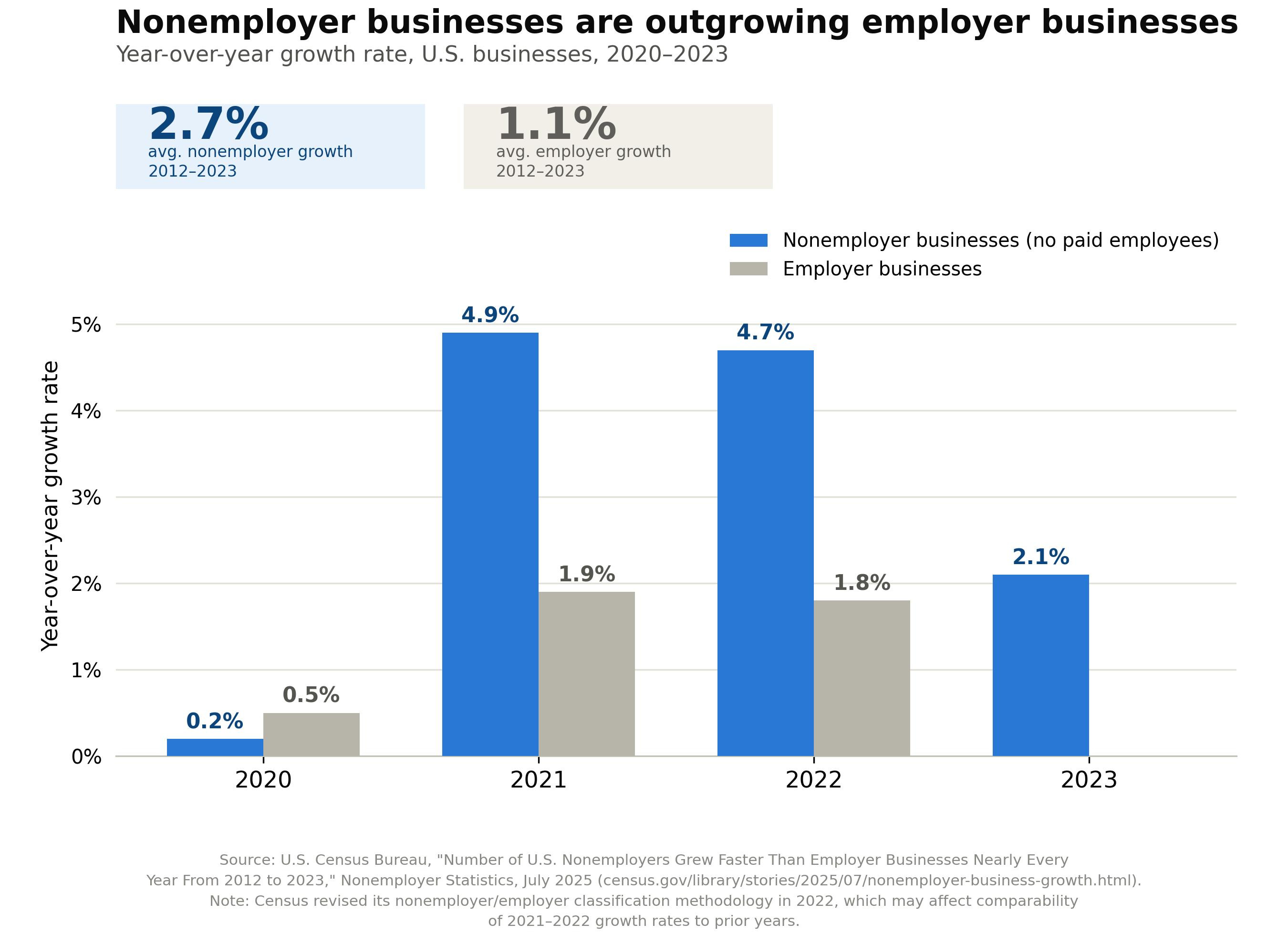
Data from the US Census Bureau showing non-employer business(one-person business) creation outpacing employer businesses by at least 2:1 over the last few years.
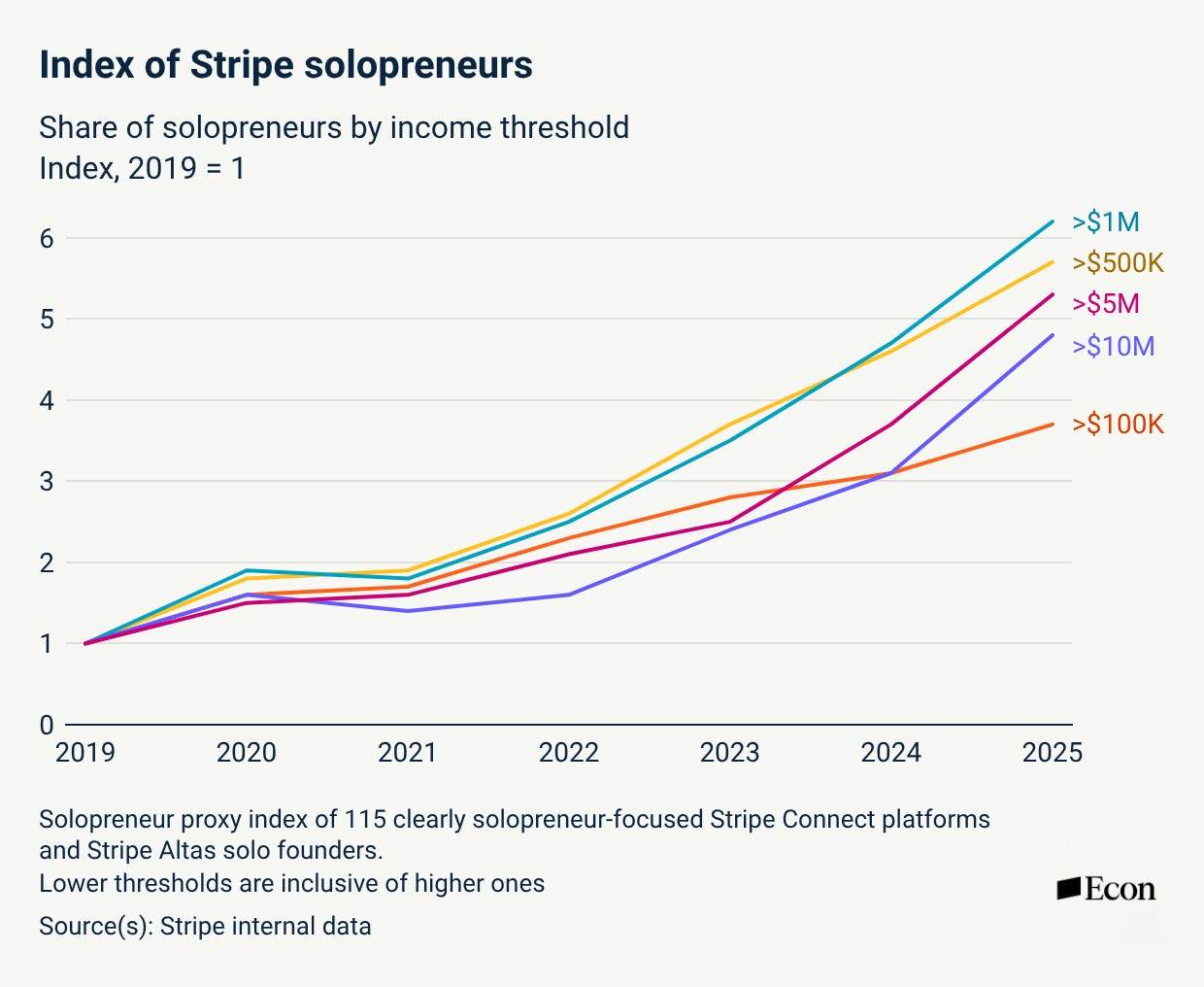
An analysis of the internal data from the payment processor Stripe revealed a sharp increase in earnings of one-person businesses. The share of 1M dollar one-person skill businesses has grown 5-fold just in the last 6 years.
So if you can solve a specific painful problem today and scale it over the internet, you will do well for yourself
And by the way I attached a downloadable “50 Problems You Can Turn Into a One-Person Skill Business” pdf you can find at the top of this article.
Alright, enough convincing. Let’s get into business.
Here’s the entire business model from start to finish.
1. YOUR STORY — You gain skills from solving your problems
It begins with your life.
Your life’s story is a laboratory for discovering value.
Start with your story.
What frustrated you?
What did you struggle to understand?
What took you years to figure out?
What transformation have you gone through?
What mistakes have taught you something?
What can you now do easily that your former self found difficult?
Before I go further, I have to say this: not every problem is valued by the market.
A solved problem does not mean a market opportunity.
What do I mean by this?
You cannot simply solve anything and expect somebody to pay you for it.
The market does not reward effort. It rewards useful outcomes.
You can spend ten years becoming incredible at something nobody wants.
So, we need to separate:
Personal value
from
Market value.
A problem becomes economically viable when enough people:
experience it
care about solving it
value the outcome
are willing or able to exchange something for the solution.
and you can communicate the before-and-after results to potential clients.
2. SPECIALIZE — Refine your skills to address a specific problem
After highlighting a solved problem in your story, you then have to use it to address a specific issue in the market.
This is why I use the term market-adjustable problems(or skills).
Your original problem doesn’t have to look like a business.
The solution, however, needs to be adjusted toward market demand.
For example:
Getting out of debt is a personal problem.
Helping young people build a system for eliminating consumer debt is market-adjusted.
The transformation gives you raw material. The market tells you how to refine it.
This balance matters.
Adjust too little, and the pool of potential clients becomes too broad. Adjust too much, and you create something so narrow that nobody needs it.
Somewhere between the two is what I call skill-market fit.
This is the framework for specialization:
Skill + Person + Problem + Approach
For example:
Fitness + busy parents + losing weight + 20-minute workouts
Suddenly something mundane becomes commercially viable.
You don’t have to change who you are. You have to translate what you know into a form the market understands.
This is the bigger picture:
Your past problem → The solution you came up with→ The skill you acquired→ Can be turned into a specialized Skill → To create a valuable product
3. MAKE YOUR VALUE VISIBLE
Now that you’ve highlighted a problem and a skill you acquired from solving it, you have to make it visible.
You don’t want to become incredibly valuable and still make nothing.
Why?
Because nobody knows about it.
Reminder: The world cannot reward value it never sees.
Creation without distribution is invisible.
Distribution without creation is empty.
You need both.
This is why the internet matters so much.
The internet is the largest marketplace humanity has ever built.
In the past:
Your customers had to be near you.
Your audience had to be reachable.
Your market is now defined not by where you live, but by who needs what you know or have.
Therefore, you have to become discoverable, not famous.
This is where people get confused.
They hear “post online” and think: I don’t want to become an influencer. Neither do I. That’s not the objective.
So, this is how you do it:
Start with one platform.
Write.
Record.
Teach.
Explain.
Create.
Demonstrate.
Share what you’re learning.
Show how you think.
Don’t immediately worry about trying to be on every platform at once.
Pick one.
Learn it.
Expand later.
Besides, give away free value.
Give away more than feels comfortable.
Teach people.
Help people.
Explain things.
Answer questions.
Give away genuinely useful information.
Why?
Because before someone buys your solution, they are making this prediction: Can this person actually help me?
Free value gives them evidence.
Every useful piece of content reduces uncertainty.
Every successful customer reduces uncertainty further.
Every useful interaction compounds reputation.
This is what I think of as the economics of trust.
Trust lowers the friction between value creation and value exchange.
Don’t constantly ask people to believe you’re good.
Make your work the evidence.
As far as starting goes, I’ll urge you to start while still employed
Another reason that makes this business model unusually accessible is that you don’t need to make a dramatic leap.
Don’t quit your job tomorrow.
Start with a few hours.
2 focused hours every week can be enough to begin:
studying your problem
improving your skill around it
posting about it
building an offer
The point isn’t that the 2 hours guarantees success.
The point is that the minimum viable commitment is surprisingly small.
You can experiment while maintaining your existing income.
Your first attempt can fail. You can try again.
Your first product can be terrible. Improve it.
Your first posts can get no attention. Keep learning.
This is why people should not think about this as one enormous irreversible bet.
Think in terms of many small, recoverable bets.
The cost to experiment via the internet is $0.
Use that.
4. MULTIPLY YOUR VALUE
“Give me a lever long enough and a place to stand, and I will move the earth.”
— Archimedes
Creating value gets you into the game.
Leverage changes the economics of the game.
Imagine you’re an excellent consultant.
You work one hour. You get one customer. You receive one payment.
Work another hour. Get another payment. That’s useful, but too linear.
Eventually you will run out of hours.
Everyone does.
You cannot store time.
You cannot manufacture another Tuesday.
You cannot invest ten hours today to gain twenty hours tomorrow.
This is why simply exchanging more and more time for money eventually becomes a bad wealth-building equation.
This is the case for most traditional jobs.
You cannot get rich if your input is closely tied to your output.
—Naval Ravikant
You want outsized outputs for every input of work. You need a leveraged mechanism to do this.
You therefore need to productize
Take something you know how to do repeatedly and turn it into something reproducible.
A skill can be distilled into a:
a framework
a template
a course
a book
software
a membership
a methodology
a licensing system
intellectual property.
The knowledge remains yours.
But now the delivery mechanism can operate without requiring the same amount of your time.
Products are value that never clocks out.
This is the crucial economic transition:
Stop asking how much work you can do.
Start asking how you can make each unit of your work produce more value.
That’s leverage.
That is how people become financially sovereign.
This isn’t about laziness.
It isn’t avoiding work.
In fact, building something valuable often requires enormous effort.
The difference is where the effort goes.
Instead of repeatedly performing the same unit of labor, you increasingly perform work that creates assets.
Content is an asset.
Reputation is an asset.
Intellectual property is an asset.
Software is an asset.
Systems are assets.
Products are assets.
An audience can become an asset.
Each can continue producing value after the initial work.
The goal isn’t to work more. The goal is to extend your value beyond your physical hours.
Use AI as leverage, not identity
AI makes this business model even more viable.
AI itself isn’t your competitive advantage.
Everyone increasingly has access to it. It is now a commodity.
Commodities don’t create differentiation. What you do with commodities does.
Use AI to:
automate repetitive work
research faster
prototype
organize information
analyze feedback
improve systems
increase output.
But don’t outsource the thing that makes your business difficult to replace:
Your judgment.
Your taste.
Your experience.
Your perspective.
Your relationship with the customer.
Let machines multiply the human, not remove the human.
5. REALIZE YOUR VALUE
This brings us to the reason I care about wealth in the first place.
Money isn’t the ultimate objective.
Money is stored optionality.
It allows you to say:
yes
no
not yet
I’m leaving
I’m starting
I’m taking the year off
I’m working on this instead.
Wealth increases your ability to choose.
And perhaps its greatest purchase is something money cannot manufacture:
Time.
We all have the same 24 hours.
You cannot store yesterday.
You cannot buy another childhood.
You cannot reproduce your twenties.
You cannot manufacture another year.
Time is the scarcest resource because it cannot be replenished.
Which is why I believe:
The greatest dividend of wealth is uncompelled time: the freedom to act from desire rather than necessity.
That’s what I’m ultimately interested in.
Not entrepreneurship for entrepreneurship’s sake.
Not becoming a CEO.
Not telling everybody to quit their jobs.
I want people to seek:
Autonomy.
Ownership.
Meaningful work.
Flexibility.
Optionality.
The ability to direct more of your finite life toward things you actually believe matter.
That is what this business provides.
The point of wealth isn’t escaping work. It is escaping compulsory work.
Work on things because you choose them.
Build things because they matter to you.
Spend time with people because you want to.
Pursue ideas because you’re curious.
Help people because you can.
Build a life you don’t need to escape from.
Design work around life instead of continually designing life around work.
The entire economic philosophy of Skillonomics
If I had to compress everything into one chain, it would be:
Story → Problem → Skill → Specialized Skill → Valuable Product → Leverage → Capital → Uncompelled Time
Your life exposes you to problems.
Solving those problems develops skills.
Market demand refines those skills.
Specialization makes you difficult to substitute.
Your specialized skill creates valuable products.
The internet multiplies those products.
Leverage decouples output from time.
Value becomes capital.
Capital buys optionality.
Optionality returns control over your time.
That’s the one-person skill business.
That’s skillonomics.
And it begins somewhere much less glamorous than most people expect: A problem.
Alright, now here’s where you start.
Thanks for reading.
I will see you next week.